

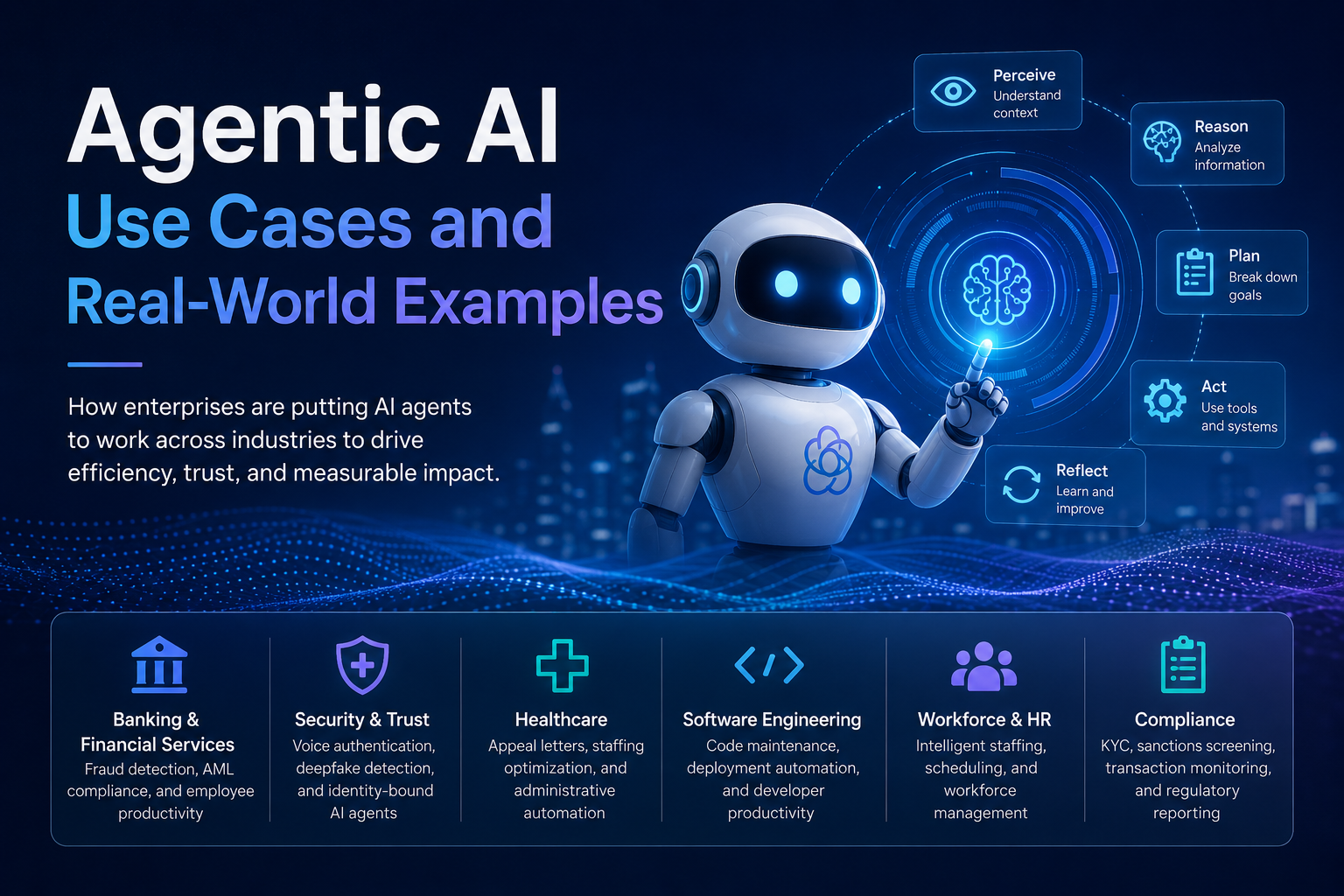
Artificial intelligence is moving beyond systems that answer questions or generate content. A growing number of enterprises are deploying AI systems that can interpret goals, gather information, choose tools, complete several steps, and take action across business workflows. This shift is creating practical agentic AI use cases in banking, healthcare, cybersecurity, compliance, software engineering, and workforce management.
The distinction matters. A generative AI system may draft a document or summarize information. An AI agent can use that output as one step inside a broader process. It can retrieve data, make a decision, call an API, update another system, check the result, and continue working toward an assigned goal. Google Cloud describes agentic AI around capabilities such as perception, reasoning, planning, action, and reflection.
Real deployments show that enterprises are not giving agents unlimited autonomy. Instead, organizations such as Wells Fargo, Intermountain Health, Spotify, Pindrop, Anonybit, and financial institutions using WorkFusion are placing agents inside defined workflows with controlled access, enterprise data, human review, and measurable business objectives.
What makes an agentic AI use case different from ordinary automation?
Traditional automation works best when a process follows fixed rules. A workflow might copy information from one system to another, trigger an email, or run a predefined script. The steps are known before the process begins.
Agentic AI becomes useful when the system needs to interpret changing information before deciding what to do next. An agent can reason over available context, select tools, create a multi-step plan, and adapt as new information appears. Google Cloud notes that tools and APIs allow agents to move beyond text generation and interact with enterprise systems.
This does not mean every workflow needs an agent. Google Cloud’s architecture guidance specifically notes that deterministic tasks such as simple translation, document summarization, or classification can often be handled more efficiently without an agentic architecture.
The strongest real-world use cases tend to appear where a process combines large amounts of information, repeated decisions, several software systems, and enough variation that rigid automation becomes difficult to maintain.
Agentic AI, Pindrop, and Anonybit: building trust around autonomous action
The search phrase agentic AI Pindrop Anonybit points to an important problem emerging around autonomous systems: trust. As agents gain the ability to access systems and act for people, enterprises need to know both who is interacting with them and whether an agent is authorized to perform a particular action.
There is an important distinction here. Public information does not establish a joint Pindrop and Anonybit agentic AI product or partnership. The two companies instead demonstrate different approaches to the same broader trust problem.
Pindrop concentrates heavily on voice intelligence, authentication, deepfake detection, and fraud risk. Its Chief Product Officer Nicholas Holland has described agentic security around three questions: whether an interaction involves the correct entity, whether the intent can be trusted, and whether the resulting action should be allowed. Pindrop is also applying agentic technology inside fraud investigations.
Anonybit, meanwhile, has focused on binding AI agents to verified human identities through privacy-preserving biometric infrastructure. Its work with SmartUp demonstrates how an enterprise agent can be associated with a verified user and given scoped authorization rather than receiving unrestricted access.
Together, these examples illustrate an emerging requirement for enterprise agentic AI. Autonomy alone is not enough. Organizations also need identity, authorization, fraud detection, auditability, and controls over what an agent can do.
Building trust with agentic AI from Pindrop
Pindrop provides a particularly clear example of using agentic AI inside a specialized operational process rather than deploying a general-purpose enterprise assistant.
Its Fraud Assist product is an AI agent designed for phone fraud investigations. The system can summarize calls, create case notes, and translate multilingual conversations into English summaries so investigators do not have to manually review every minute of recorded audio.
The goal is not to remove fraud analysts from the decision process. Instead, the agent reduces the investigation work required before a person reaches a decision. That distinction is important in financial services because investigators need evidence, consistency, and traceable case information.
A Pindrop case study involving First National Bank of Omaha, or FNBO, reported that Fraud Assist reduced investigation times by around 35 to 40 percent, increased case productivity by 42 percent without additional staff, and improved decision accuracy when used alongside Pindrop Protect signals. These figures come from Pindrop’s customer deployment data and should therefore be understood as vendor-reported results.
This is a useful model for building trust with agentic AI from Pindrop. The agent operates inside a narrow domain, receives signals from an established fraud platform, performs evidence-heavy preparation work, and leaves high-stakes judgment within a controlled investigation process.
How Anonybit is making AI agents identity-bound
Anonybit approaches trust from another direction. Instead of concentrating primarily on identifying fraudulent conversations, it asks how an autonomous agent can prove that it has permission to act for a real person.
In May 2025, Anonybit and SmartUp announced an implementation designed to create privacy-preserving, identity-bound AI agents across workflows such as payments, order management, procurement, and supply chains.
The architecture combines biometric verification, decentralized storage, identity tokens, and scoped authorization. An agent can therefore be associated with a verified individual and authorized for specific actions rather than inheriting broad permissions simply because it has access to an application.
This becomes increasingly important as enterprise AI agents move from retrieving information to approving transactions, changing records, initiating purchases, or communicating with outside systems. The security question changes from simply asking whether an agent has valid credentials to asking whether it is acting for the correct person, with valid consent, within an approved scope.
The Anonybit example shows why identity may become part of the agent architecture itself, rather than an authentication step performed only when the user first signs in.
Google Cloud agentic AI at Wells Fargo
Banking provides another strong example because financial institutions combine huge information environments with strict controls and complex internal processes.
In August 2025, Wells Fargo and Google Cloud expanded their relationship around agentic AI. Wells Fargo became an early adopter of Google Agentspace, whose agent capabilities have since become part of Gemini Enterprise.
The deployment is intended to give employees including branch bankers, investment bankers, marketers, customer-relations teams, and corporate employees access to AI agents and enterprise AI tools.
The practical focus is information discovery and workflow execution. Agents can help employees search across enterprise knowledge, synthesize relevant material, and automate tasks that previously required people to move among several systems.
The Google Cloud agentic AI Wells Fargo example also illustrates why enterprise deployment requires more than access to a powerful model. Financial institutions need permissions, security controls, reliable corporate information, governance, and an architecture capable of managing agents at organizational scale.
Rather than replacing bankers, the deployment is positioned around increasing employee capacity. Wells Fargo expects agents to help its workforce reach information faster and reduce the amount of manual effort involved in routine workflows.
WorkFusion AI agents for banking compliance and AML
Financial crime compliance is particularly suited to specialized agents because analysts repeatedly gather evidence, review alerts, check different sources, document findings, and decide which cases require escalation.
WorkFusion AI agents for banking compliance and AML are designed around those specific activities. The company provides agents for sanctions and politically exposed person screening, adverse-media monitoring, enhanced due diligence, know-your-customer processes, payment screening, and transaction monitoring.
These agents do more than generate summaries. They collect information, analyze records, process documents, apply compliance logic, record evidence, disposition appropriate alerts, and pass higher-risk situations to human analysts.
That model is significant because financial institutions face large volumes of alerts, many of which require repetitive investigation before analysts determine whether meaningful risk exists. WorkFusion says its agents are designed to perform work associated with Level 1 reviews and some Level 2 investigations while keeping decisions documented and explainable.
WorkFusion began launching its purpose-built compliance agents before the current agentic AI boom and introduced generative AI enhancements in 2024. In February 2026, UiPath acquired WorkFusion, expanding UiPath’s agentic automation capabilities for financial services and financial crime compliance.
The example demonstrates an important enterprise pattern: narrow agents trained around a well-defined business process may create more immediate value than general agents that attempt to handle every type of work.
Dan Liljenquist, Intermountain Health, and AI agent appeal letters
Healthcare organizations spend considerable time on administrative workflows that involve large amounts of clinical and financial information. Insurance appeals are a clear example.
Intermountain Health has applied AI to the process of preparing payer appeal letters. Dan Liljenquist, Intermountain’s Chief Strategy Officer, told Becker’s Hospital Review that the organization was using AI to retrieve the information needed for an appeal and was taking roughly 30 minutes out of the preparation time for each appeal letter.
An appeal can require staff to review extensive records, identify the relevant clinical information, understand why a claim was denied, and assemble evidence supporting the case. AI can reduce the search and synthesis burden before staff complete the final submission.
The Dan Liljenquist Intermountain Health AI agent appeal letters example shows why administrative healthcare is likely to become an important agentic AI category. Many processes sit between structured data, medical documentation, payer requirements, and human review.
They are too variable for simple automation but structured enough to define clear goals and controls.
The healthcare lesson is also broader than time savings. Agentic systems can increase capacity without requiring clinical or administrative specialists to spend the same amount of time gathering information manually. Human oversight remains particularly important because the result can affect payment, regulatory compliance, and patient-related operations.
Spotify’s agent AI use case for software deployment and maintenance
Software engineering has become one of the fastest-moving areas for AI agents. Spotify provides a useful example because its deployment builds on years of internal engineering standardization rather than treating an AI coding tool as an isolated product.
Spotify had already developed Fleet Management and its underlying Fleetshift system to make maintenance changes across large numbers of software components. According to Spotify Engineering, the company has merged more than 2.5 million automated maintenance pull requests through this system.
Simple code changes could be automated with deterministic scripts. More complex migrations were harder because the scripts had to account for large numbers of edge cases.
Spotify responded by developing Honk, a background coding agent that uses Claude through an internal harness and runs sessions in Kubernetes pods. The agent can handle more complex code modifications while Spotify’s existing engineering infrastructure manages targeting, pull requests, testing, standards, and review.
This makes the Spotify agent AI use case for deployment especially instructive. Spotify did not replace its development platform with an AI agent. It inserted agentic reasoning into the part of the process where deterministic automation became difficult.
The company’s existing Backstage developer platform also gives agents access to consistent information about software components, ownership, documentation, and internal engineering standards. Spotify exposes capabilities through tools including MCP interfaces, allowing agents to work within the same standardized environment used by engineers.
Spotify reported in June 2026 that more than 99 percent of its engineers used AI coding tools weekly and that pull-request frequency had risen 76 percent, with most PRs involving developers working alongside an AI agent.
The larger lesson is that standardized infrastructure can make AI agents more effective. Agents perform better when software, documentation, APIs, permissions, and workflows are predictable.
Agentic AI in healthcare staffing
Healthcare staffing presents another promising agentic AI use case because organizations constantly need to reconcile worker availability, credentials, scheduling constraints, labor costs, and changing patient demand.
In April 2026, UnityAI introduced StaffOps, an agentic staffing and labor platform that connects workforce scheduling with electronic health record data. Fierce Healthcare reported that the platform was operating across roughly 120 sites of care at the time.
The system is designed to adjust staffing decisions as appointment volumes, cancellations, patient flow, and workforce availability change. This is more dynamic than producing a static schedule because the operating environment continues to change after the original plan is created.
Ceipal is applying a similar agentic model to staffing agencies. Its healthcare platform connects recruiting, credentialing, onboarding, scheduling, and workforce processes through a common data layer. Its agents can monitor credential requirements, search for matching clinicians, initiate outreach, and move parts of the staffing workflow forward automatically.
These systems show how agents can coordinate decisions across workflows that previously required repeated human checks.
Can healthcare staffing create an agentic AI data moat?
The phrase agentic AI healthcare staffing moat data flywheel switching costs describes a strategic effect that could emerge from these platforms, although it should not be treated as an automatic result of deploying AI.
An agent working inside a staffing platform can observe which candidates respond, which credentials expire, which workers accept assignments, which facilities cancel shifts, how quickly roles are filled, and which staffing decisions lead to better utilization.
If that information is collected responsibly and converted into useful operational signals, the system can improve matching and workflow decisions over time. Better decisions generate more usage. More usage can create more high-quality operational data. That produces the potential for a data flywheel.
Integration can strengthen the effect. Once a staffing platform is deeply connected to credentialing records, workforce schedules, candidate histories, EHR-related demand signals, payroll processes, and compliance rules, replacing it may require substantial migration and integration work.
Those factors can create switching costs, but they should not be confused with an unavoidable competitive moat. Data quality, interoperability, privacy requirements, customer ownership of information, regulation, competing platforms, and model commoditization can all weaken the advantage.
The defensible asset is therefore less likely to be the underlying language model. It is more likely to be the combination of proprietary workflow data, domain-specific rules, integrations, user trust, operational history, and the ability to run agents reliably inside real healthcare processes.
What these real-world agentic AI use cases have in common
The most useful examples share several design characteristics.
They begin with a specific operational problem. Pindrop focuses on fraud investigation. WorkFusion addresses financial crime compliance. Intermountain Health targets the administrative burden involved in payer appeals. Spotify uses agents where complex software maintenance exceeds the capabilities of deterministic scripts.
They also connect the AI system to tools and enterprise context. An agent without access to reliable information or approved actions remains little more than a sophisticated conversational interface.
Strong deployments preserve controls around important decisions. Fraud cases can still involve investigators. Insurance appeals remain part of an accountable healthcare process. Code changes move through engineering workflows. Banking agents operate inside security and governance requirements.
Finally, successful implementations measure operational outcomes rather than simply counting AI interactions. Time per case, investigation capacity, pull-request frequency, compliance workload, staffing utilization, and employee productivity are more meaningful measures than the number of prompts sent to a model.
Where agentic AI creates the most value
Agentic AI is most useful when a workflow contains enough ambiguity to require reasoning but enough structure to define an objective.
A process becomes a stronger candidate when employees must repeatedly gather information from several sources, choose between possible actions, move through multiple systems, document what they did, and adjust when circumstances change.
That is why banking compliance, healthcare administration, fraud investigations, software maintenance, and healthcare staffing are emerging as practical categories.
By contrast, introducing an agent into a simple deterministic workflow can add unnecessary model costs, latency, unpredictability, and governance requirements. Enterprises should not begin with the question, “Where can we deploy an AI agent?” They should begin by identifying workflows where existing automation breaks because a human must constantly interpret context before deciding what happens next.
The next phase of enterprise agentic AI
The current generation of agentic AI use cases shows that the technology is moving from isolated chat interfaces into operational systems.
Wells Fargo is bringing agents into enterprise knowledge and employee workflows. WorkFusion is embedding specialized agents inside AML operations. Intermountain Health is reducing the administrative work involved in insurance appeals. Spotify is allowing coding agents to operate inside standardized engineering infrastructure. Pindrop is applying agentic technology to fraud investigations, while Anonybit is addressing the identity and authorization problem created when autonomous systems begin acting for people.
These examples also show the limits of the technology. Enterprise agents need controlled tools, reliable data, identity, permissions, monitoring, auditability, and clear escalation paths.
The competitive advantage will therefore come from more than choosing the strongest model. Organizations that redesign workflows, connect agents to high-quality enterprise context, establish clear controls, and measure operational performance will be better positioned to move agentic AI from experimentation into durable production systems.